L-MOUNT Forum

Register a free account now!

If you are registered, you get access to the members only section, can participate in the buy & sell second hand forum and last but not least you can reserve your preferred username before someone else takes it.

Test/ First Impression Sigma TC-2011 2x Teleconverter First Impression

Lsake

Active Member
Joined
Mar 23, 2023
Messages
175
Today I took a walk with the Sigma TC-2011 2x Teleconverter attached to my Sigma 100-400mm f5-6.3 DG DN and Lumix S5. The teleconverter turns this lens into a 200-800mm f10-13. The sun was mostly out with minimal cloud in the sky so I had ideal conditions for the slow aperture. After a few hours of using it completely hand held here are my take aways:

  • The dual stabilisation is excellent even at 800mm.
  • It is an incredibly light 800mm FF setup
  • Loss of image quality seems minimal so long as your close enough to the subject
  • The TC does shift the focus and zoom rings a bit further away from the body
  • ISO 8000 on the S5 might even perform better than 3200
Below are a couple of images captured with the TC. I used a bit if AI noise reduction in LR on the crow because I had to lift the shadows quite a lot to bring back feather details (Jet black birds can be tricky like that). So far I would consider this a usable setup in good outdoor lighting. I will hopefully be able to use it for a much longer time this weekend.

Robin Caught Mid Preen by Peter North, on Flickr

Crow by Peter North, on Flickr
 
Thank you for sharing your experience. Can you tell something about the autofocus with TC in comparison without.
So far the only things I've noticed regarding auto focus are:

  • The hunting pulse when locking onto a subject seemed more jarring, this may be the massive focal range it was searching as I didn't set the focus limiter on the lens
  • The burst mode in AFC sounded slower, but could have been my settings so will have to retest that
In terms of detecting subjects and aquiring focus it didn't feel slower, I didn't struggle more than I normally would, animal detection worked the same as without the TC. The biggest difference is just having to more strictly manage your shutter speed, if you think you need to move to 1/800+ speeds you have to really consider if the light is going to support you. Thankfully with the stabilisation and ISO performance on the S5 you can get away with ISO 10,000 shots fairly easily. I did take a shot at ISO 25k that has cleaned up reasonably well with lightrooms new AI noise reduction.
 

Part 2​

Yesterday I had another few hours to test the TC-2011 in some more mixed light conditions. It was pretty overcast initially, and I did think it would be a waste of time.

Some key findings of the day:

  • I was able to get sharp shots at 800mm with shutter speeds as low as 1/160
  • haze can be a real problem at longer distances
  • Good post processing software is key to squeezing the most out of images taken with the TC
  • Images are definitely a bit softer vs without the TC. But you have to examine at 100% to really see it
  • AFC does not feel as reliable. I was in AFC the whole time in high burst and it missed quite a lot even on static subjects.
Below is an image taken at 1/160 shutter speed at 800mm hand held from a standing position. It feels like the stabilisation is just as effective at 800mm as it is natively at 400mm. The sky was still quite grey when taken.

Grey Squirrel by Peter North, on Flickr

Below is an image that has been cropped and shot at ISO 10,000. AI noise reduction applied in Lightroom has basically cleaned it all up. The wren was in a bush inside woodland, quite a dark scenario.

Wren by Peter North, on Flickr

Below was an image taken at quite a distance, maybe 40 metres. The ground was wet with a visible haze over the field. The detail isn’t great, but I think this is more down to the haze rather than the ridiculously slow 1/125 shutter.

Magic Horses by Peter North, on Flickr

Below is an image with quite a bit of post processing, including Photoshop to correct the wing mangled by the electronic shutter. Despite AFC not doing great, this was more luck than anything else.

Swallow by Peter North, on Flickr
 
Why are you using electronic shutter?
I was mostly in a quiet woodland type of environment, looking to spot perched birds. For this the S5 electronic shutter is fine as there wont’t be any noticeable distortion, and it’s completely silent so doesn’t scare things away.

The swallow was unexpected, I’d not seen any this year, must be the first to arrive. I was trying to photograph a coot swimming around the water surface when the swallows started skimming the water. I opportunisticly tool some spray and pray bursts, I didn’t realise until later that I was still in electronic shutter.
 

Part 2​

Yesterday I had another few hours to test the TC-2011 in some more mixed light conditions. It was pretty overcast initially, and I did think it would be a waste of time.

Some key findings of the day:

  • I was able to get sharp shots at 800mm with shutter speeds as low as 1/160
  • haze can be a real problem at longer distances
  • Good post processing software is key to squeezing the most out of images taken with the TC
  • Images are definitely a bit softer vs without the TC. But you have to examine at 100% to really see it
  • AFC does not feel as reliable. I was in AFC the whole time in high burst and it missed quite a lot even on static subjects.
Below is an image taken at 1/160 shutter speed at 800mm hand held from a standing position. It feels like the stabilisation is just as effective at 800mm as it is natively at 400mm. The sky was still quite grey when taken.

Grey Squirrel by Peter North, on Flickr

Below is an image that has been cropped and shot at ISO 10,000. AI noise reduction applied in Lightroom has basically cleaned it all up. The wren was in a bush inside woodland, quite a dark scenario.

Wren by Peter North, on Flickr

Below was an image taken at quite a distance, maybe 40 metres. The ground was wet with a visible haze over the field. The detail isn’t great, but I think this is more down to the haze rather than the ridiculously slow 1/125 shutter.

Magic Horses by Peter North, on Flickr

Below is an image with quite a bit of post processing, including Photoshop to correct the wing mangled by the electronic shutter. Despite AFC not doing great, this was more luck than anything else.

Swallow by Peter North, on Flickr

These are quite good for 1/160s at 800mm but I can't help but feel that especially for moving subjects the motion blur would be reduced if the shutter was faster. It's difficult to evaluate the sharpness of the TC when it's unclear how much it is impacted by the slow shutter speeds.
 
Just found this now in my search for experiences of the Sigma 2x TC. I guess you're quite impressed with it overall?
 
Just in case that's interesting:
I have the Sigma and Pana 2x TC's.

For a 2x TC my experiences are so quite good. I used both with a S1R and S1Rii. Lenses Panasonic 70-200 f2.8, Sigma 105 f2.8 macro and Sigma 150-600 DG DN.
And used the Sigma in the Panasonic lens and the Panasonic in Sigma lenses. I was not able to spot a real difference in optics or performance. Nevertheless, the Panasonic one has two additional pins.

I think the AF performance is really depending to how the AF System is able to deal with the big f-stops. I once read that at some values PDAF does not work well anymore.
 
Just in case that's interesting:
I have the Sigma and Pana 2x TC's.

For a 2x TC my experiences are so quite good. I used both with a S1R and S1Rii. Lenses Panasonic 70-200 f2.8, Sigma 105 f2.8 macro and Sigma 150-600 DG DN.
And used the Sigma in the Panasonic lens and the Panasonic in Sigma lenses. I was not able to spot a real difference in optics or performance. Nevertheless, the Panasonic one has two additional pins.

I think the AF performance is really depending to how the AF System is able to deal with the big f-stops. I once read that at some values PDAF does not work well anymore.
So, I have both the Sigma and Panasonic 1.4x TCs.

I agree there is nothing between them from an IQ perspective.

However, I found that when the Panasonic TC is used on a Sigma lens, the correct aperture and focal length are not reported.

However, using the Sigma TC (with the latest firmware) on a Panasonic lens works just fine.

I looked for a way to update the firmware of the Panasonic TC and found nothing.

Did your Panasonic TC report correct EXIF data when used with the Sigma lenses?
 
FWIW, here is a very interesting article comparing 1.4 & 2.0 TCs. It uses Nikon Z hardware, but it’s interesting nonetheless, and the author has a good methodology.


I’m considering trying a 2.0 TC with my Sigma 500/5.6 and Panasonic 70-200 F2.8. With the Sigma, that puts me at F11, but it’s such a sharp lens wide-open that may be OK. With the S-Pro, I’d almost certainly stop down to F4 or even F5.6 to get peak sharpness out of the lens when used with the 2.0 TC.

It will be interesting to see how upsampled images taken using the 1.4 TC compare to those with the 2.0 TC, especially when you incorporate the resulting change in ISO. @NFec, have you tried comparing upsampled 1.4x images with 2.0x images?
 
FWIW, here is a very interesting article comparing 1.4 & 2.0 TCs. It uses Nikon Z hardware, but it’s interesting nonetheless, and the author has a good methodology.
That is a good article, thanks. My thought is modern AI upres can trump a 2X teleconverter.
 
That is a good article, thanks. My thought is modern AI upres can trump a 2X teleconverter.
That's an interesting conjecture. Anyone fancy doing an experiment??
 
That's an interesting conjecture. Anyone fancy doing an experiment??
Yes, I think we should. First step is to do a bare lens vs. 1.4x TC, which I could do on several lenses. Then compare a 1.4 to a 2.0, but I don’t have a 2.0 TC.
 
It’s interesting - what questions do we want answered?

One is - am I better off shooting the lens bare & AI upsampling vs. using a TC? Or, upsampling a 1.4x shot vs. a 2.0x shot? What if we include effect of ISO? This is basically the Photography Life test repeated but using AI to do the upsampling (and L-mount hardware, of course).

Another is - am I better off using a sharp lens with a TC vs. a softer, longer lens with no TC? So, the 70-200 F2.8 S-Pro with 1.4x and 2.0x TCs vs the 70-300 or 100-400. Or simply using the upsampled shots from the sharper lens? Does the answer change if I equalize the depth of field between the two?

Of course, once you answer the first question then you can decide how to conduct the second test.

Another test I could do: 500/5.6 with 2.0x TC vs 100-600 with 1.4x. I suppose I should order a 2.0x, or at least start looking for a good used unit.

Not sure if I’ll have time to do this justice over the next four weeks, as I have a two-week trip to Mexico coming up. But I’ve already found that I prefer a 280mm raw file created by the 70-200 F2.8 S-Pro using a 1.4x TC that has been appropriately cropped & upsampled (using Capture One) to a 400mm field of view (whew!) to a native 400mm raw out of the 100-400. I *think*. Should probably do that test again to make sure the conclusion is valid. Keep in mind that the 70-200 F2.8 is bitingly sharp at 200mm & F5.6. But it should be, considering how heavy it is.

Anyway, it could be interesting.
 
FWIW, here is a very interesting article comparing 1.4 & 2.0 TCs. It uses Nikon Z hardware, but it’s interesting nonetheless, and the author has a good methodology.


I’m considering trying a 2.0 TC with my Sigma 500/5.6 and Panasonic 70-200 F2.8. With the Sigma, that puts me at F11, but it’s such a sharp lens wide-open that may be OK. With the S-Pro, I’d almost certainly stop down to F4 or even F5.6 to get peak sharpness out of the lens when used with the 2.0 TC.

It will be interesting to see how upsampled images taken using the 1.4 TC compare to those with the 2.0 TC, especially when you incorporate the resulting change in ISO. @NFec, have you tried comparing upsampled 1.4x images with 2.0x images?
Hi George,

I just checked to topic with the EXIF data. I experience that several years back, but I thought this wrong submission of data was with the Sigma TCs and that it was done after installing firmware updates. But I was wrong the issue is really with using the Panasonic TCs with other lenses. The camera receives the same F-Stop and focal length information like the TCs is not in place. I used both TCs in both lenses, without really recognizing a difference in handling / performance. What I could think about is, that things like stabilization or automatic image corrections might not be applied correctly. But as said, I saw in my use not difference.
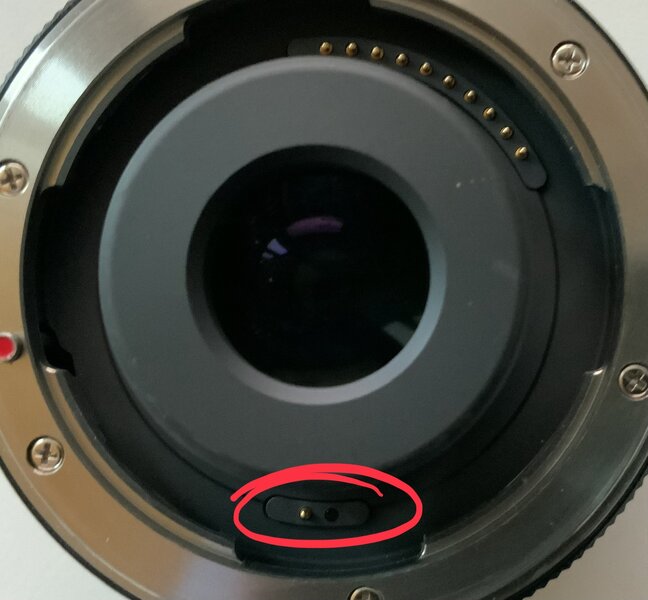
In regards the TCs and mounts of Sigma and Panasonic lenses, there is a difference! Panasonic added 1-2 more electronic contacts to the mount. Sigma just uses the normal connections/ pin out. Here is a picture of the Panasonic 2x TC mount which is put into the lense. Interesting: The TCs has just one PIN but the lens has two pads…


IMG_6075.jpeg


I did not compare TC to upscaling yet. At the end I saw for me the benefit of not needing to crop and post-edit later. In common addition more glas will add negative effects for sure. And a TC will enlarge in addition every imperfection. Call me old fashioned, but I like enlarging things with glas instead of AI or upscaling algorithms. At the end AI optimizations can be added to.

If this is from interested, I can take 4 shots using my Sigma 105 DG DN macro: no TC vs. Sigma 1.4 TC vs Sigma 2.0 TC vs Panasonic 2.0 TC and then we check if there are really visible differences
 
Yes, I think we should. First step is to do a bare lens vs. 1.4x TC, which I could do on several lenses. Then compare a 1.4 to a 2.0, but I don’t have a 2.0 TC.
I don't have a 2X teleconverter, and a new one is $750 so I'm not too interested in tnat. I can try something with the Lumix 70-200 f/4 and the 1.4X. I would suggest you use LR Super Resolution (or at least compare it to Capture One).
 
Hi George,

I just checked to topic with the EXIF data. I experience that several years back, but I thought this wrong submission of data was with the Sigma TCs and that it was done after installing firmware updates. But I was wrong the issue is really with using the Panasonic TCs with other lenses. The camera receives the same F-Stop and focal length information like the TCs is not in place. I used both TCs in both lenses, without really recognizing a difference in handling / performance. What I could think about is, that things like stabilization or automatic image corrections might not be applied correctly. But as said, I saw in my use not difference.
In regards the TCs and mounts of Sigma and Panasonic lenses, there is a difference! Panasonic added 1-2 more electronic contacts to the mount. Sigma just uses the normal connections/ pin out. Here is a picture of the Panasonic 2x TC mount which is put into the lense. Interesting: The TCs has just one PIN but the lens has two pads…


View attachment 16590


I did not compare TC to upscaling yet. At the end I saw for me the benefit of not needing to crop and post-edit later. In common addition more glas will add negative effects for sure. And a TC will enlarge in addition every imperfection. Call me old fashioned, but I like enlarging things with glas instead of AI or upscaling algorithms. At the end AI optimizations can be added to.

If this is from interested, I can take 4 shots using my Sigma 105 DG DN macro: no TC vs. Sigma 1.4 TC vs Sigma 2.0 TC vs Panasonic 2.0 TC and then we check if there are really visible differences
Interesting - the Panasonic 1.4x TC also has the extra pin you circled above. And, while my Panasonic 70-200 has a contact for that pin, none of my Sigma lenses which accept TCs do. I wonder what that extra pin does. Thinking this through, it could be that the Panasonic lenses & TCs use this extra pin to enable the lens to understand the magnification factor of the attached TC - or perhaps even just to detect the presence of the TC - while Sigma - with the updated TC firmware - found a way to do that without the extra pin. This would explain why Sigma lenses don’t transfer corrected EXIF data through Panasonic TCs.
 
Back
Top