L-MOUNT Forum

Register a free account now!

If you are registered, you get access to the members only section, can participate in the buy & sell second hand forum and last but not least you can reserve your preferred username before someone else takes it.

S1Rii - Best camera "for landscapes and more" according to DPReview

It's a while since I've been over to DPR, but here you have it - they finally agree with me!!
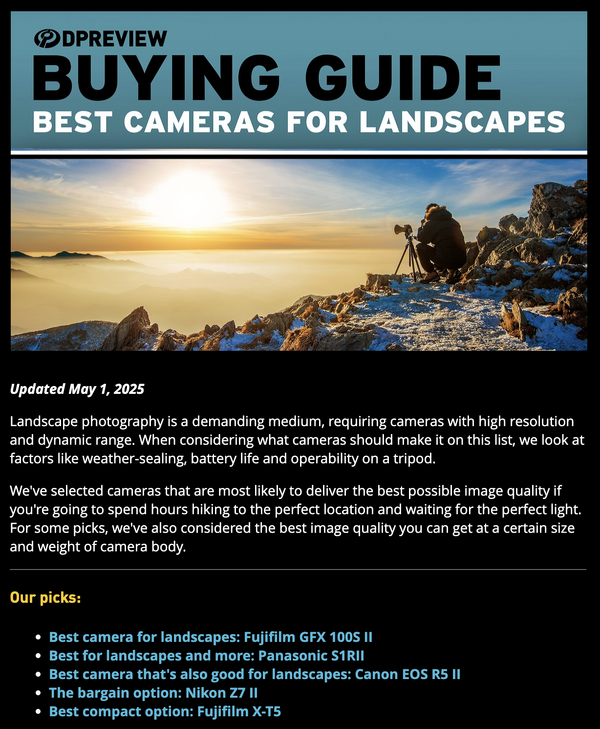
Something is not right when DPR actually recommends a LUMIX camera.

LOL, I just had a look at the article and saw that they were critical of the AF tracking and subject detection, in an article about landscape photography. Z04 Auslachen
 
For me, the Lumix S1Rii could be the last ILC I ever need. It does all I need and with the latest FW update, it became even better.

I am super happy with it for sports and normal photography.
 
With the good weather sealing, top dynamic range and useful high resolution modes, not a surprise.
 
I think we reached a new peak in technology for ILC. Not only Lumix cameras. All brands.

I watched yesterday the newest youtube review from Gerald Undone about the Canon R6 MKiii. He made a similar statement and he said that it is basically a waste of time for him, to test sensor performance or AF in cameras in the future, only to detect miniscule differences, which are invisible in real life scenarios.

Fuji and Panasonic might be in very specific scenarios still behind Sony, Canon and Nikon regarding AF. But this is only for the most demanding use cases and 99% of the people will not need this extra 5% AF performance.

Even the Lumix S1Rii, which was not designed for sports photography has a "good enough" AF for sports.

No matter which brand you choose or which modern sensor the newest camera has (24MP, 46MP, 60MP etc.), it is excellent. Noone will look at 1600% enlargement in Photoshop to spot any kind of differences.

Who shoots above ISO 12800? Noone. If you search for images in Flickr, you will see that there is a huge drop in available images at or above ISO 6400, because 99% of users do not need these high ISO values. Who shoots in a dark cole mine?

Differences in DR at lower ISO are minor among the brands. Hardly to see (within the same sensor size) in real life shooting.

We are now back in the 80ies with a time machine. Today's sensors are like film. Fuji Velvia is Fuji Velvia, no matter in which camera.

The race for significant better cameras or sensor technology is over until the next new innovation. I do not see this happen for the next 5 years.

Therefore we can relax and focus what kind of haptics, usability, body shape, menu structure and lens choice we prefere or need and pick then the appropriate system.

I am a fan of the L-Mount because of the 3 founding partners and their capabilities to deliver a future proof system, great lens choice and lens sizes which are smaller than possible with i.e. Nikon's bigger Z-Mount and at an affordable price point.

I like the menu structure of my S1Rii, the body shape for my hands, usability of all the buttons and wheels and the EVF and tilting screen. It does not feel like a computer. It feels like a camera and has a better price/performance ratio than the competition.

I love the Sigma i-series lenses with their aperture ring, very small size and great image quality. It feels like Leica and Zeiss in the 80ies, but at an affordable price. Real photography to enjoy the process, not just the final image.

I do not get this combination with other brands.

I really can not think of a feature I miss with the S1Rii, except maybe pixel binning like with the Leica Q3. But no other brand has this function either.
 
I think we reached a new peak in technology for ILC. Not only Lumix cameras. All brands.

I watched yesterday the newest youtube review from Gerald Undone about the Canon R6 MKiii. He made a similar statement and he said that it is basically a waste of time for him, to test sensor performance or AF in cameras in the future, only to detect miniscule differences, which are invisible in real life scenarios.

Fuji and Panasonic might be in very specific scenarios still behind Sony, Canon and Nikon regarding AF. But this is only for the most demanding use cases and 99% of the people will not need this extra 5% AF performance.

Even the Lumix S1Rii, which was not designed for sports photography has a "good enough" AF for sports.

No matter which brand you choose or which modern sensor the newest camera has (24MP, 46MP, 60MP etc.), it is excellent. Noone will look at 1600% enlargement in Photoshop to spot any kind of differences.

Who shoots above ISO 12800? Noone. If you search for images in Flickr, you will see that there is a huge drop in available images at or above ISO 6400, because 99% of users do not need these high ISO values. Who shoots in a dark cole mine?

Differences in DR at lower ISO are minor among the brands. Hardly to see (within the same sensor size) in real life shooting.

We are now back in the 80ies with a time machine. Today's sensors are like film. Fuji Velvia is Fuji Velvia, no matter in which camera.

The race for significant better cameras or sensor technology is over until the next new innovation. I do not see this happen for the next 5 years.

Therefore we can relax and focus what kind of haptics, usability, body shape, menu structure and lens choice we prefere or need and pick then the appropriate system.

I am a fan of the L-Mount because of the 3 founding partners and their capabilities to deliver a future proof system, great lens choice and lens sizes which are smaller than possible with i.e. Nikon's bigger Z-Mount and at an affordable price point.

I like the menu structure of my S1Rii, the body shape for my hands, usability of all the buttons and wheels and the EVF and tilting screen. It does not feel like a computer. It feels like a camera and has a better price/performance ratio than the competition.

I love the Sigma i-series lenses with their aperture ring, very small size and great image quality. It feels like Leica and Zeiss in the 80ies, but at an affordable price. Real photography to enjoy the process, not just the final image.

I do not get this combination with other brands.

I really can not think of a feature I miss with the S1Rii, except maybe pixel binning like with the Leica Q3. But no other brand has this function either.
That’s a really good amatissais Dirk. I think you nailed it!
 
I think we reached a new peak in technology for ILC. Not only Lumix cameras. All brands.


I am a fan of the L-Mount because of the 3 founding partners and their capabilities to deliver a future proof system, great lens choice and lens sizes which are smaller than possible with i.e. Nikon's bigger Z-Mount and at an affordable price point.

I like the menu structure of my S1Rii, the body shape for my hands, usability of all the buttons and wheels and the EVF and tilting screen. It does not feel like a computer. It feels like a camera and has a better price/performance ratio than the competition.

I love the Sigma i-series lenses with their aperture ring, very small size and great image quality. It feels like Leica and Zeiss in the 80ies, but at an affordable price. Real photography to enjoy the process, not just the final image.

I do not get this combination with other brands.

I really can not think of a feature I miss with the S1Rii, except maybe pixel binning like with the Leica Q3. But no other brand has this function either.
I agree. Because my needs are not very advanced in most cases, I think I already felt this way one generation ago.
For me the really good IBIS, the HHHR and the good video features without artificial limitations are the key point- ah, and the access to good lumix lenses like the primes, excellent sigma lenses, and a growing amount of oddballs like anamorphic or cheaper options.
 
I feel the same. Most things I'd want in a camera are purely computational or things that would make handling ever so easier. Something like an Internal ND, for example, or - comparable to HHHR - maybe a feature that allows focus stacking/exposure stacking in-camera, i.e. you get directly the output in RAW instead of having to do it yourself after the shooting.

But in terms of "photography", I really struggle to see much more possibility for actual, optical improvement. Sure, more MP and less noise is always nice - and usually you can have either but not both -, but the performance envelope for modern cameras is so wide, I just don't see any big jumps on the horizon.
 
Computational advancements will be the way forward, there is much to achieve there. Already we have handheld/tripod high resolution modes that semi-intelligently stitch together multiple photos to improve resolution and reduce noise. Even ignoring resolution, the advantage of having 8 1/8 sec exposures over a single 1 sec exposure is that you now have temporal resolution to each of your pixels. With the right algorithm (likely some ML) you could use this extra information to gain the noise benefits of longer exposure time without the motion blur and with the ability to discard moments of untwanted disturbance during the duration of exposure - stacking exposures in astrophotography is the least difficult version of this. Some lumix cameras try to reduce motion blur in their high-res mode in a naive manner, but there is so much untapped potential here.

We have the high burst rates, video improvements, and processing power. In a few years we might have true gigapixel see-in-the-dark cameras that basically shoot videos to compute photos.
 
Last edited:
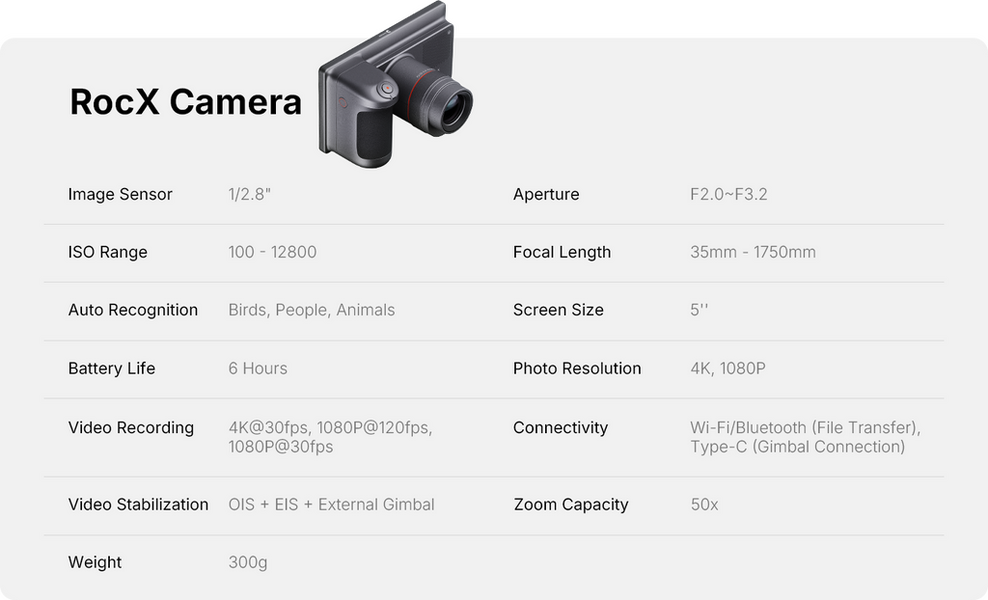
Yes, Lumix is innovating (LUTs, Cropless E-Stabilization, hybrid and crop zoom, HHHR shot, etc.), and DJI too (they put a square sensor in the last Osmo Action 6 camera), but there are more, here one example:

RocX - World's First AI-powered Distant View Camera:


With a long-distance shooting assistant. Creayed by former DJI engineers. For 200$.

1_41fd623a-643b-4cfb-9192-1d778c3fa8b0.png

 
Back
Top
