L-MOUNT Forum

Register a free account now!

If you are registered, you get access to the members only section, can participate in the buy & sell second hand forum and last but not least you can reserve your preferred username before someone else takes it.

The Case for APS-C (again)

Lsake

Active Member
Joined
Mar 23, 2023
Messages
182
According to recent data in camera sales, crop sensors were significantly more popular in 2025:

“In 2025, brands shipped more bodies with APS-C and Micro Four Thirds sensors, with more than 4.45 million. Bodies with full-frame or larger sensors (such as medium format) shipped around 2.54 million.” - Digital Camera World

Imagine a £599 version of the S9 with an APSC sensor that could mount all of sigmas f1.4 and f2.8 crop lenses.

1771492658284.png
 
I still enjoy my Leica CL and plan to start using the Sigma 100-400 I just bought for my SL2-S, with the CL, considering the CL the “1.5x crop TC” for that lens.
 
I still enjoy my Leica CL and plan to start using the Sigma 100-400 I just bought for my SL2-S, with the CL, considering the CL the “1.5x crop TC” for that lens.
The 100-400mm works great with the CL. I have the exact combo. The IQ is great and you get the extra reach. Only thing is the CL isn't really a “wildlife” cam so requires a bit more patience vs using something like an S5II or SL2-S. I also enjoy using the CL with the Leica 18mm f2.8 pancake lens because it’s just so compact and light.
 
According to recent data in camera sales, crop sensors were significantly more popular in 2025:

“In 2025, brands shipped more bodies with APS-C and Micro Four Thirds sensors, with more than 4.45 million. Bodies with full-frame or larger sensors (such as medium format) shipped around 2.54 million.” - Digital Camera World

...
Yes, that's nothing new. Full frame has a much smaller maket share compared to APS-C. Currently, APS-C is by far the majority of the market and it's almost impossible to have a market share above 10 % if you don't offer APS-C.

But the in terms of total value, full frame tops APS-C, even though less units sold. APS-C (and MFT) makes about half the total market in terms of units sold in 2025, but less than 30 % in value. Full frame makes only about a third on terms of units, but half in value of the total market.
 
What I don't get is that if APS-C is a better seller than FF, why do the main manufacturers of ILCs provide such a limited range of APS-C lenses (apart from Fuji of course). Look at Canon and Nikon in particular, but also Sony, and their APS-C range is pretty limited.

Drilling into the CPIA stats a bit, this is their reported 2025 data at the top level:

1771502281755.png


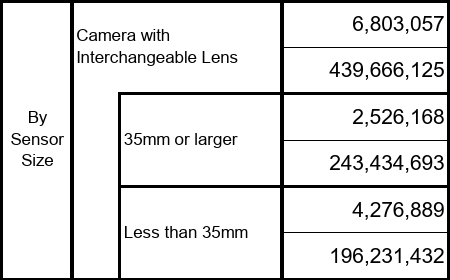
The top numbers are numbers of units shipped, the bottom number are value (in thousands of Yen).

So, we can see that FF or larger (probably 99% FF since MF must be tiny in comparison) is smaller in shipments (2.5m vs 4.2m), but higher in value (243bn Yen in value vs 196bn Yen).

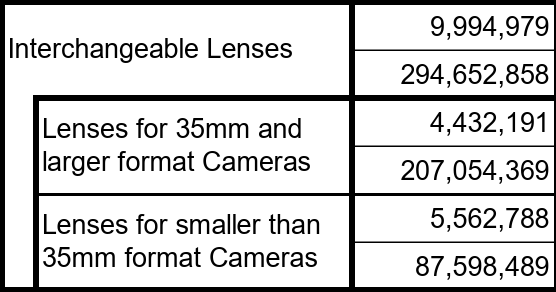
Where it comes to lenses, the numbers are much closer in terms of units, but FF lenses accounted for over 2x the revenue for APS-C.

1771502387660.png
 
What I don't get is that if APS-C is a better seller than FF, why do the main manufacturers of ILCs provide such a limited range of APS-C lenses (apart from Fuji of course). Look at Canon and Nikon in particular, but also Sony, and their APS-C range is pretty limited.

Drilling into the CPIA stats a bit, this is their reported 2025 data at the top level:

View attachment 16696

The top numbers are numbers of units shipped, the bottom number are value (in thousands of Yen).

So, we can see that FF or larger (probably 99% FF since MF must be tiny in comparison) is smaller in shipments (2.5m vs 4.2m), but higher in value (243bn Yen in value vs 196bn Yen).

Where it comes to lenses, the numbers are much closer in terms of units, but FF lenses accounted for over 2x the revenue for APS-C.

View attachment 16697
Why are there fewer OEM APS-C lens options? As your data eludes to; They’re not as profitable for the manufacturer as the bigger more expensive FF lenses. Also the typical APS-C customer probably isn’t even going to buy some of the high end specialist lenses available to “professional” FF systems.
But this financial reality for the manufacturer doesn’t really mean anything to the average photography hobbyist. It’s not like someone is going to buy a full frame system over APS-C because they’re worried about the manufacturers profit margins. In fact, I’d assume the inverse of that logic, many of these buyers are probably picking APS-C systems precisely because they cost less, the lenses cost less, and the systems tend to be overall smaller and lighter.
An APSC system might be a lower profit margin for the manufacturer, but it’s still profit.
 
I don't think I've yet got over the fact that Leica chose not to make me a CL2 with IBIS and 30ish megapixels :).

Sigma are pretty good with their Aps-c offerings but I think some FF users add Aps-c bodies to use as an extender.
 
...

View attachment 16696

The top numbers are numbers of units shipped, the bottom number are value (in thousands of Yen).

So, we can see that FF or larger (probably 99% FF since MF must be tiny in comparison) is smaller in shipments (2.5m vs 4.2m), but higher in value (243bn Yen in value vs 196bn Yen).

Where it comes to lenses, the numbers are much closer in terms of units, but FF lenses accounted for over 2x the revenue for APS-C.

View attachment 16697

Exactly. That's the point. A average full frame has two to three times the value of a average APS-C. Even if we considering the gross margin the same, a company has to sell two to three times as many APS-C cameras compared to full frame cameras, for the same total profit. In reality, APS-C sales are only about 1.5 times higher than full frame sales.

Back in the day, when digital camera sales where much higher, especially the slice of the cake for APS-C was even much higher. If I remember correctly (I have to switch the statistic), full frame sales where less than 5 % of the market about 10 years ago and APS-C sold ten to twenty times as much units. That's obviously not the case anymore.

Nowadays full frame is much more interesting for the manufacturer, because it's way more profitable, even though the sales are still much lower.
 
Imagine a £599 version of the S9 with an APSC sensor
It would certainly be a much cheaper camera than the Fujifilm X100VI (€1,800), the Ricoh GRIV (€1,350), or the Sony A6700 (€1,300-€1,500)... And it would have a very similar price to the Nikon Z30, which, with all due respect, is a terrible camera, hahaha.

I suppose we'd be talking about a new 24MP APS-C sensor but with the excellent features of the S9, like Ibis and the video recording modes. I don't know, I don't see it. If you can already find a used S9 for around €800, I don't see any advantage to a €700 APS-C camera... Unless it is much smaller...

The only advantage is the original resolution for photography, but with the high-resolution mode in-camera or in Lightroom, I still don't see the benefits, since you can use APS-C lenses on an S9 with a 10.7MP resolution.
 
Given that Panasonic are heavily into m43 as well as FF, it would be a very brave decision for them to get into APSC as well!

But a Sigma BF/APSC with IBIS and an EVF would I’m sure be a popular camera and Sigma have a good range of APSC specific lenses for it.
 
What I don't get is that if APS-C is a better seller than FF, why do the main manufacturers of ILCs provide such a limited range of APS-C lenses (apart from Fuji of course). Look at Canon and Nikon in particular, but also Sony, and their APS-C range is pretty limited.
I have the Sony a6700 as an easy to carry APS-C camera. Yes, the range of Sony APS-C lenses is somewhat limited. But the camera uses the same mount as Sony's full frame cameras, so I can use any of the vast selection of Sony FF lenses. Right now I have the tiny Viltrox 28mm FF pancake lens on the camera, and this camera/lens combination is truly pocket size.
 
Given that Panasonic are heavily into m43 as well as FF, it would be a very brave decision for them to get into APSC as well!
It seems to be a brave decision to get them to make a small M43 camera.
 
It would certainly be a much cheaper camera than the Fujifilm X100VI (€1,800), the Ricoh GRIV (€1,350), or the Sony A6700 (€1,300-€1,500)... And it would have a very similar price to the Nikon Z30, which, with all due respect, is a terrible camera, hahaha.

I suppose we'd be talking about a new 24MP APS-C sensor but with the excellent features of the S9, like Ibis and the video recording modes. I don't know, I don't see it. If you can already find a used S9 for around €800, I don't see any advantage to a €700 APS-C camera... Unless it is much smaller...

The only advantage is the original resolution for photography, but with the high-resolution mode in-camera or in Lightroom, I still don't see the benefits, since you can use APS-C lenses on an S9 with a 10.7MP resolution.
What if an APSC S9 could fit in an EVF? What about an APSC S5II where the 100-500 acts like a 150-750?
 
What if an APSC S9 could fit in an EVF? What about an APSC S5II where the 100-500 acts like a 150-750?
There are benefits for a smaller sensor. But APS-C cameras aren't that much cheaper anymore. An APS-C S9 with evf would maybe be more expensive than the S9. The sensor could be cheaper. But the evf would increase the costs. Look at the price ranges of APS-C cameras with Ibis and evf from the competitors.

Also a APS-C S5II would probably be not much cheaper compared to the S5II. Look at the G9II. And for more range, you also could get something like S1RII and use it's crop potential as well as have more quality if you don't need the range.
 
It comes to my mind the Nikon Z50ii, with EVF but without IBIS and about 850€ price.. I don't know, I still don't see it for Lumix. Maybe Sigma?
I think Sigma would be the most likely source in L mount, they have some history of aps-c bodies, and really are the only offering for crop lenses. Not convinced they would see a large enough market.
 
In digital photography, 36x24 has always been treated as the Medium to Large format equivalent. Manufacturers have actively tried to keep that "Pro" aura around it, and charged equivalent prices. Bodies and lenses. Sony started to sell cheaper, older model A7's as a gateway drug, but that's since disappeared and they've gone all premium again for 36x24. Both Canon and Nikon treated APSC as the Red headed stepchild, and used it as a gateway drug into the larger, more "Pro" 36x24. If you want great lenses for your APSC body, here, buy the FF ones. More expensive, economy of scale got better, profits went up. You can see it right to this day. Canon killed the EOS M mount, replaced it with RF S, then started re-releasing the exact same lenses with just a mount change. If you want good quality lenses, buy our RF 36x24 ones. Profit.
Olympus bet the house that m4/3 was going to be the 35mm film equivalent. To their detriment. It didn't. It nearly broke them once, Sony bailed them out, it broke them properly, and they're no longer. People simply aren't willing to pay top $$ for what they perceive as lesser quality, just because it has a smaller sensor. Panasonic has learned from this, and diverted all -or most of their resources into 36x24. Because it's simply more profitable. It's quite obvious if you look at some of the overlap in size and weight of both bodies & some lenses. G9II vs S5 I & II. GX series bodies have all but disappeared. PL 8-18 vs S 14-28mm, or 20-60mm. Time will tell if Panny do a Sony and start lifting prices above what they now are -being the best value for $$ out there. Once they get enough of a foothold.
No way known Panasonic would ever bring out an APSC camera after their m4/3 experience. I'd bet lots of money on that
 
In digital photography, 36x24 has always been treated as the Medium to Large format equivalent. Manufacturers have actively tried to keep that "Pro" aura around it, and charged equivalent prices. Bodies and lenses. Sony started to sell cheaper, older model A7's as a gateway drug, but that's since disappeared and they've gone all premium again for 36x24. Both Canon and Nikon treated APSC as the Red headed stepchild, and used it as a gateway drug into the larger, more "Pro" 36x24. If you want great lenses for your APSC body, here, buy the FF ones. More expensive, economy of scale got better, profits went up. You can see it right to this day. Canon killed the EOS M mount, replaced it with RF S, then started re-releasing the exact same lenses with just a mount change. If you want good quality lenses, buy our RF 36x24 ones. Profit.
Olympus bet the house that m4/3 was going to be the 35mm film equivalent. To their detriment. It didn't. It nearly broke them once, Sony bailed them out, it broke them properly, and they're no longer. People simply aren't willing to pay top $$ for what they perceive as lesser quality, just because it has a smaller sensor. Panasonic has learned from this, and diverted all -or most of their resources into 36x24. Because it's simply more profitable. It's quite obvious if you look at some of the overlap in size and weight of both bodies & some lenses. G9II vs S5 I & II. GX series bodies have all but disappeared. PL 8-18 vs S 14-28mm, or 20-60mm. Time will tell if Panny do a Sony and start lifting prices above what they now are -being the best value for $$ out there. Once they get enough of a foothold.
No way known Panasonic would ever bring out an APSC camera after their m4/3 experience. I'd bet lots of money on that
I agree with most of that, but I’m not sure m43 is as dead as you paint it. For sure there is the value problem - it’s a tough call to convince people to pay similar money for a smaller sensor, even though the differences in design and production costs between FF and m43 are almost certainly minimal. But I do think m43 has a role to play, because although you can cherry pick to arrive at the view that size and weight are comparable, I think overall an m43 system will be smaller and lighter. And its IQ is probably good enough for most people.
 
I agree with most of that, but I’m not sure m43 is as dead as you paint it. For sure there is the value problem - it’s a tough call to convince people to pay similar money for a smaller sensor, even though the differences in design and production costs between FF and m43 are almost certainly minimal. But I do think m43 has a role to play, because although you can cherry pick to arrive at the view that size and weight are comparable, I think overall an m43 system will be smaller and lighter. And its IQ is probably good enough for most people.
I don’t think Olympus are relevant to the question of L mount APSC viability.

You can still buy Olympus MFT cameras, for legal reasons they’re not Olympus branded anymore. Olympus corporation were forced to divest from many of its businesses, including microscopy. This was mostly due to it being involved in one of the largest accounting scandals in Japanese corporate history, and the billions in investment losses and fines the parent corporation had to make up for. From what I understand Sonys investment was to Olympus Corporation. Not specifically to the Olympus digital camera sub-division.

On the subject of MFT, it seems to me Lumix have prioritised development in L mount. Hence why there hasn’t really been a new MFT model in a decade. To me it would make more sense for them to start transitioning those “entry level” and compact options into the L mount and an APSC sensor would be a better fit.

I think there’s a good chance we could see a new APSC L mount camera. The 18-40mm kit lens seems like it was designed for use on both formats. Sigma continue to offer APSC lenses in L mount. I would have thought they’d discontinue these since nobody sells such a camera, maybe they know something we don’t?
 
Hence why there hasn’t really been a new MFT model in a decade.
In fact Panasonic have launched a number of new MFT models in the past decade:

- GH7 (June 24)
- G9ii (Sept 23)
- GH6 (Feb 22)
- GH5ii (June 21)
- G100 (June 20)

And there have been lenses too:

- 25-50 f1.7 (July 21)
- 9mm f1.7 (May 22)
- Mark ii versions of the 12-35, 35-100, and the 100-400 (various dates in 22 and 23)

Given how mature the m43 lens range is, this isn't a bad record.
 
Back
Top